What is Ajrakh Print? History, Making Process & Sarees | Vasanam India
▶ Introduction
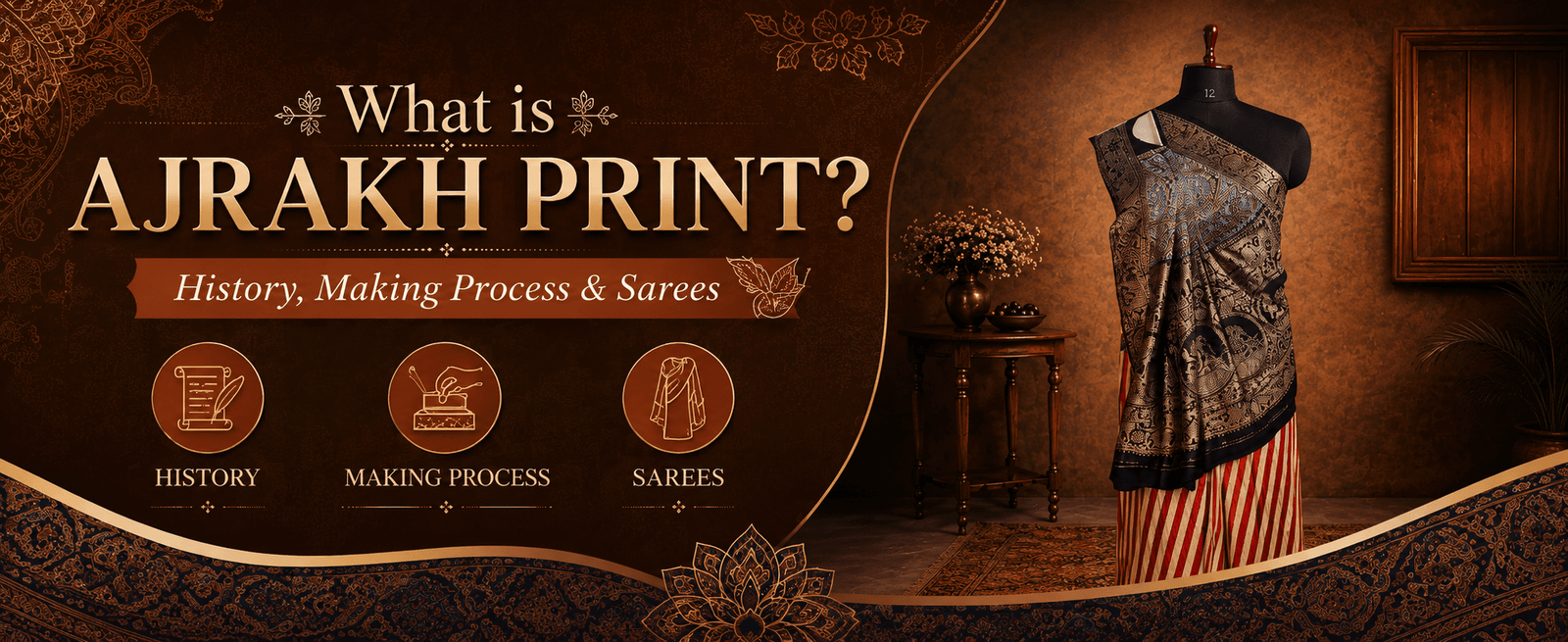
Ajrakh is one of the world’s oldest textile traditions — a block-printing art form that has survived for over 4,000 years in the Kutch region of Gujarat and the Sindh province. The word ‘Ajrakh’ is believed to derive from the Arabic ‘Azrak’, meaning blue — the colour most associated with this ancient craft.
Ajrakh silk sarees from Vasanam India bring this 4,000-year legacy to your wardrobe with exquisite golden zari borders and rich natural dyes.
▶ History of Ajrakh
The origins of Ajrakh can be traced to the Indus Valley Civilisation (3000–1500 BCE), making it one of the oldest documented fabric printing traditions in the world. The Khatri community of Kutch and Sindh have been the primary custodians of this craft for centuries.
Ajrakh was historically worn by the Maldharis (nomadic herdsmen) of Kutch as turbans and shawls. The geometric patterns were believed to represent the night sky — the stars, the moon, and the cosmic order.
In 2001, the devastating Gujarat earthquake nearly wiped out the Ajrakh community, but artisans rebuilt their craft with international support. Today, Ajrakh has GI (Geographical Indication) protection from the Government of India.
▶ How Ajrakh is Made - The 14-Step Process
Creating an authentic Ajrakh saree takes up to 14–21 days and involves over a dozen steps:
1. Saaj (Preparation): Fabric is washed, beaten, and sun-dried
2. Khari (Starching): Fabric is treated with camel dung and water (natural softener)
3. Resist application: A mixture of lime and gum is applied using wooden blocks to areas that should resist the dye
4. First dye bath: Indigo dye is applied for the blue colour
5. Washing: Excess dye is washed off
6. Second resist application: Another round of block printing with a different resist
7. Alizarin dye: Red dye derived from madder root is applied
8. Washing and sun-drying
9. Repeat steps 3–8 multiple times (up to 16 repetitions)
10. Final wash, dry, and finish
The result is a saree with symmetrical patterns on both sides — a hallmark of authentic Ajrakh.
▶ Ajrakh Colours and Motifs
Traditional Ajrakh uses only three colours:
• Indigo blue — from the indigo plant
• Madder red — from the madder root (alizarin)
• Black — from iron-rich mud
All three are natural, eco-friendly, and biodegradable.
Common Ajrakh motifs:
• Eight-pointed stars (symbolising the cosmos)
• Geometric medallions
• Diagonal hash patterns
• Border repeat patterns
▶ Vasanam India Ajrakh Saree Collection
Our Ajrakh Silk Sarees feature:
• Premium silk fabric with rich texture
• Golden zari border — a modern addition that elevates the traditional design
• Available in black, blue, and off-white
• Price: ₹4,499 (was ₹4,999)
• Free shipping across India
▶ Shop Ajrakh Sarees at Vasanam India
Visit vasanamindia.in/product-category/silk-ajrak-print/
Use code SUMMER15 for 15% off on prepaid orders.